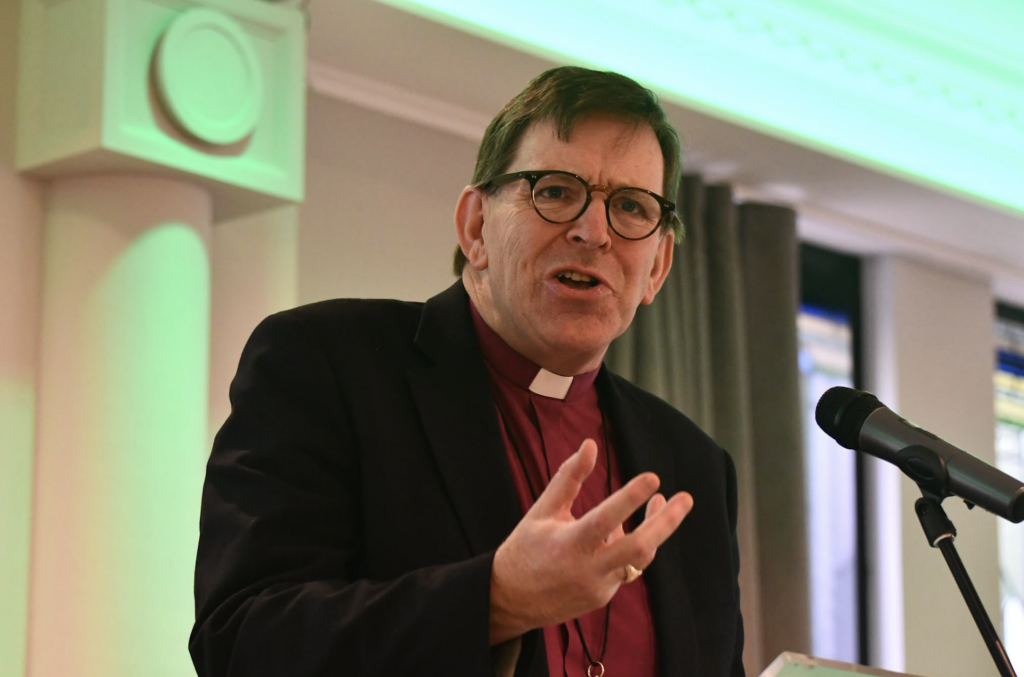
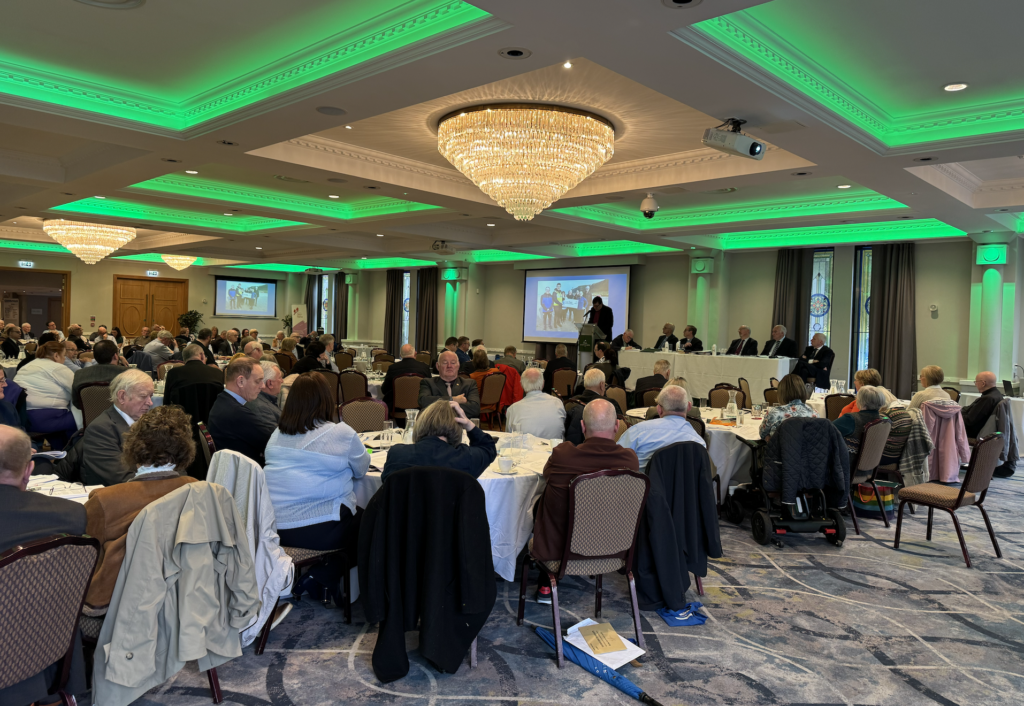
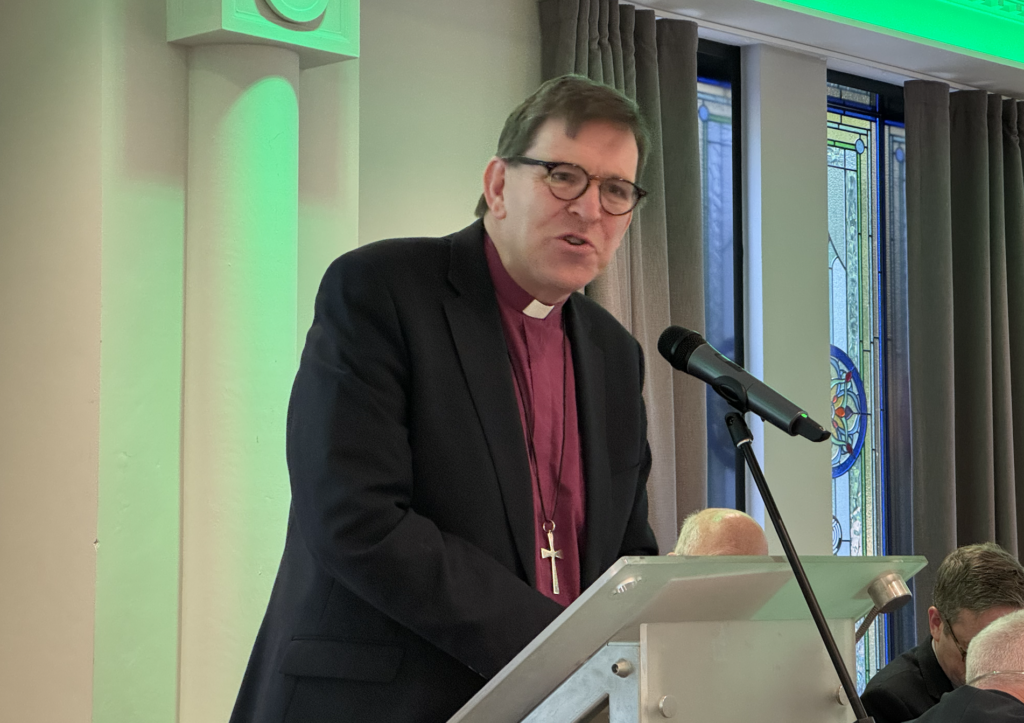
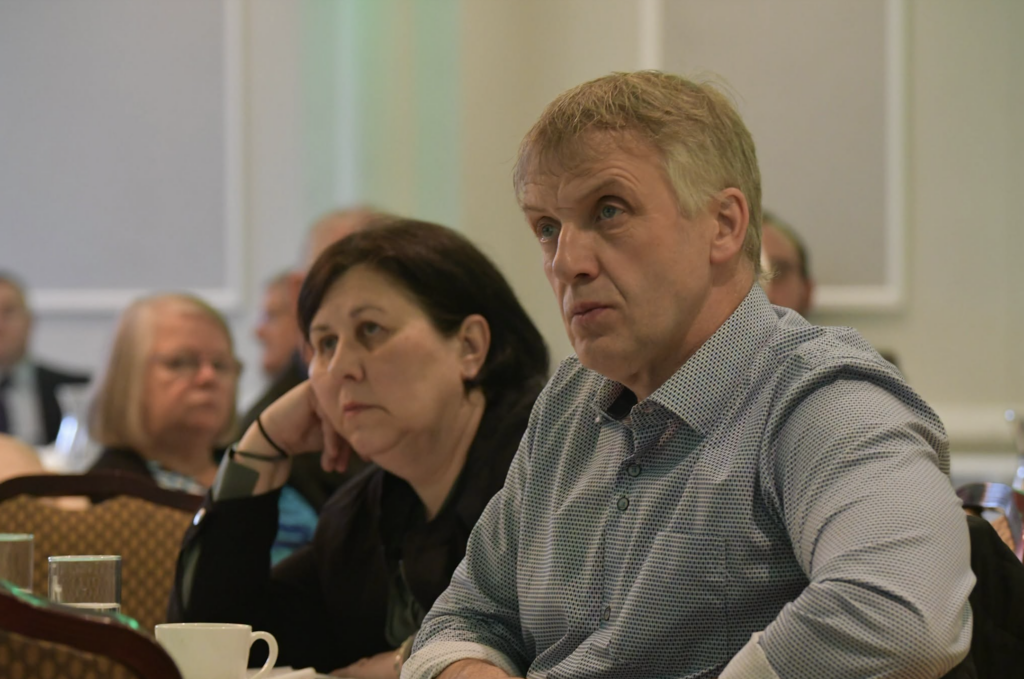
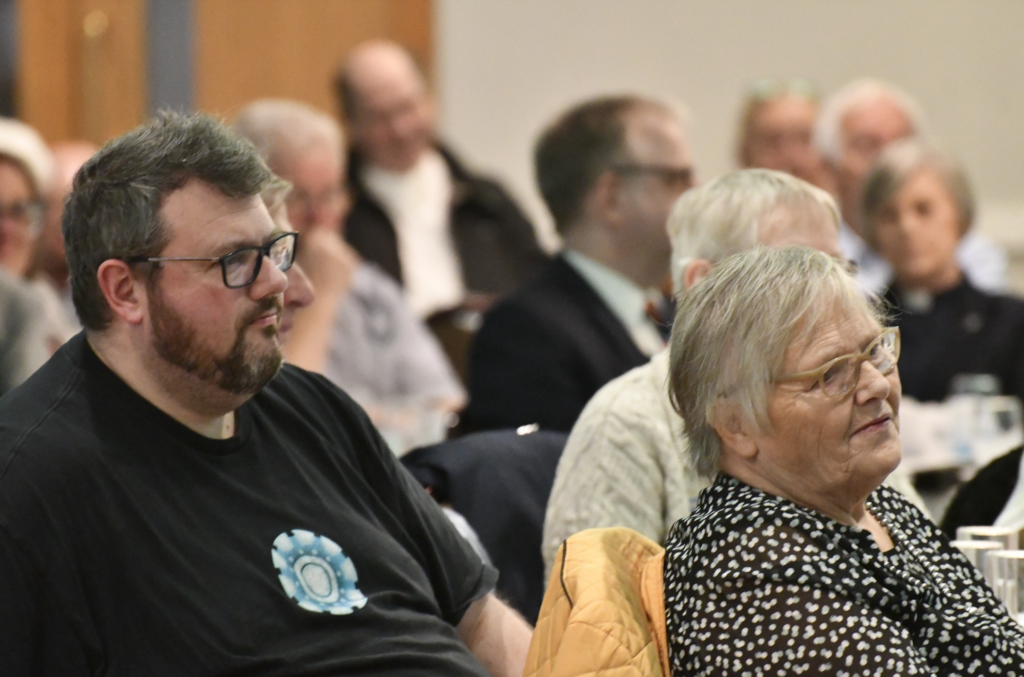
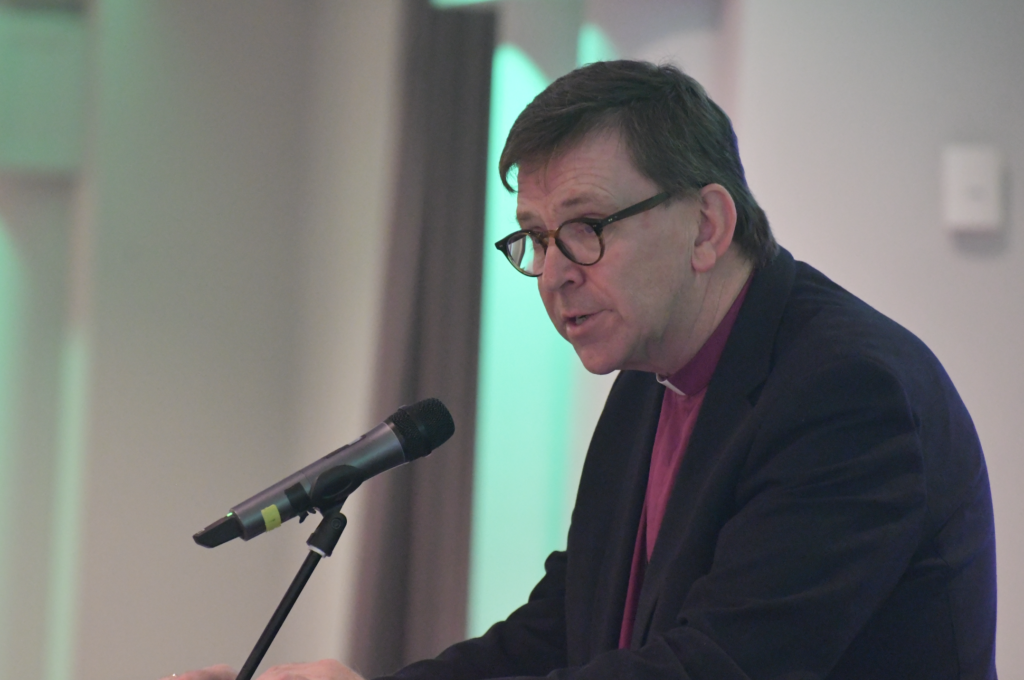
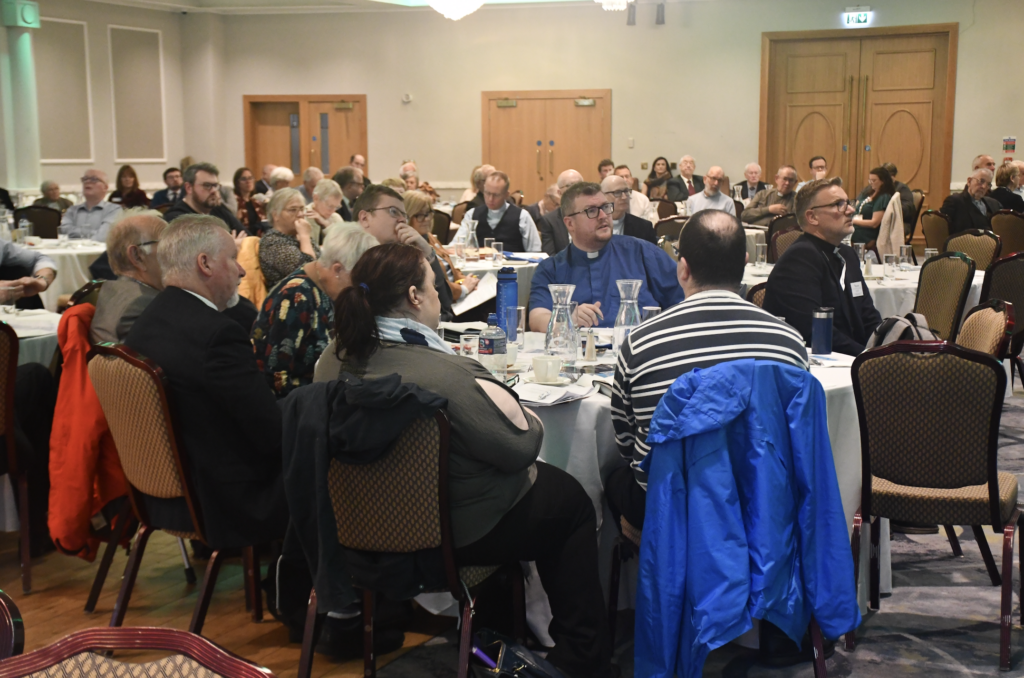
Bishop Andrew urged delegates at the 2026 Diocesan Synod to ‘play their part’ in the work of reconciliation in our communities. His call came in his Presidential Address to synod members from every corner of the Diocese of Derry and Raphoe, who had gathered in Londonderry’s Everglades Hotel for the occasion.
“Recent events in our province have reminded us all too clearly,” the Bishop said, “that we remain a deeply divided society. There are still barriers between communities, deep-rooted suspicions and painful memories, and we should not underestimate the work that remains to be done in all parts of our diocese.”
Bishop Andrew encouraged delegates to play their part. “Let reconciliation be more than a theme for a conference or a phrase in a speech, or a word to be used. Let it be something we practise in our relationships, in our parishes and in our communities. Let us be people who, because we believe in the resurrection, dare to believe that things can be different.”
Bishop Andrew’s Presidential Address in full is reproduced below.
Presidential Address to the Annual Diocesan Synod of Derry and Raphoe
21st October 2026
Welcome and thanksgiving
It is a great pleasure to welcome you all to our annual Diocesan Synod.
I want to begin by saying a sincere thank you to each and every one of you – both clergy and lay – for all that you do throughout the year in the life of your local parishes and across the ministry of our wider diocese.
So much of the life of our Church depends upon the generous giving of people’s time, energy, gifts and, above all, their prayers. Whether you serve on a select vestry, lead worship, work with children and young people, visit the sick and housebound, maintain our buildings, support those in need, or simply offer a listening ear and a word of encouragement, you are contributing to the life and witness of the Church and the building up of God’s Kingdom in our large and diverse diocese.
Much of this work happens quietly and often goes unrecognised, but it matters enormously. I want you to know how grateful I am for all that you do and also assure you that no work done for God goes unrecognised by God. It is blessed by God, and it builds his Kingdom.
Our Synod is an important opportunity to come together, not simply to conduct the business of the diocese, important though that is, but to reflect on the work of God in Derry and Raphoe. It is an opportunity to give thanks for what he is doing among us, to be honest about the challenges we face, and to seek together the growth of his kingdom across our diocese and beyond.
It remains a huge privilege – a great privilege in my life – to serve as your bishop. I am continually moved and humbled when I visit our parishes, meet our clergy and parishioners, when I witness the faith, commitment and generosity of God’s people.
I see people working faithfully for the blessing of their churches and their communities. I see people supporting one another through difficult times, reaching out to those in need, and seeking to live out their Christian faith in the ordinary circumstances of everyday life.
These encounters for me are a constant reminder that the Church is not simply an institution or a collection of buildings. It’s the people of God, called together in Christ, equipped through the power of the Holy Spirit, and sent into the world to serve him.
And that’s the perspective I want us to keep before us today. We come together with our hopes and our concerns, our opportunities and our challenges, but above all we come together with confidence in the God whom we serve.
Reconciliation: a journey worth travelling
I want to reflect on some of the things that have happened in the last year. One of the most significant and historic occasions in the life of our diocese, not just this year but for many years, was the visit of the Anglican Consultative Council to the city in July.
It was a remarkable day, and a real privilege for Derry and Raphoe to welcome representatives of the Anglican Communion from right across the world, including the Archbishop of Canterbury, Dame Sarah Mullally.
I want to express my heartfelt thanks to the large band of cheerful, generous and welcoming volunteers from parishes across the city who helped make the day such a success. Their enthusiasm and hospitality were a wonderful expression of the welcome we wanted to offer to our international guests. I think they represented our diocese exceptionally well, and I’m deeply grateful to every one of them.
The Anglican Consultative Council brings together Anglicans from across the globe, from very different contexts and cultures, yet united in our common faith. To welcome them here was a reminder that, although our local circumstances across the communion matter greatly, we belong to something much bigger than ourselves: a worldwide family of faith.
The theme of the day was reconciliation, and it was a particularly appropriate theme for this city and for this part of the world. We know that reconciliation is not something that can be achieved in a moment. It’s a journey. It’s often slow and sometimes painful. It requires patience, courage, honesty and a willingness to listen. It also recognises the wounds of the past without allowing those wounds to determine the possibilities of the future.
Recent events in our province have reminded us, all too clearly, that we remain a deeply divided society. There are still barriers between communities, deep-rooted suspicions and painful memories, and we should not underestimate the work that remains to be done in all parts of our diocese.
And yet, alongside these divisions, I see reconciliation taking place every day. Reconciliation at grassroots level. I see it in friendships that cross perceived boundaries; in fellowship between people who might once have regarded each other with suspicion; and in individuals and communities who are discovering that they have more in common than they maybe imagined.
They may seem like small things, but small things matter; they are not insignificant. Indeed, they may be among the most important things that happen in our society.
As followers of Jesus Christ, we believe that reconciliation lies at the very heart of God’s purposes for humanity – reconciliation with us and God, and reconciliation one with another. Through the death and resurrection of Jesus, God has opened up a new way of living with him and with one another.
We are resurrection people. We believe that the power of Christ can bring life out of death, hope out of despair, and the possibility of a new beginning where human experience might suggest that all is lost. It’s not, because we are resurrection people.
Reconciliation does not mean pretending that the past did not happen – that’s not reconciliation. It doesn’t mean overlooking the pain and suffering that we have experienced, that many people in this room have experienced. Reconciliation is not about denying hurt or demanding that people simply move on. It is about finding a way forward in which the past is acknowledged, where relationships can be renewed, and where a better future becomes possible. And we have to be patient in our well-doing to see God’s Kingdom grow.
That raises a question for each and every one of us, and for every parish represented here today, but even more important than that for every child of Jesus Christ represented here today: what part can we – or do we – play in the work of reconciliation?
What can we do in our own communities, wherever we are in the diocese? Who might we invite into conversations? What friendships might we encourage? What opportunities might we create for people to meet, to listen, to discover one another afresh?
To take a step towards reconciliation is not to be disloyal to those who have suffered in the past. It is to recognise suffering while also seeking a future for the generations who will follow us. The journey will be slow. There will be setbacks, and there will be times when progress seems painfully small. But every step matters, however modest it appears. And the alternative is very, very bleak.
So, I want to encourage all of us to play our part. Let reconciliation be more than a theme for a conference or a phrase in a speech, or a word to be used. Let it be something we practise in our relationships, in our parishes and in our communities.
Let us be people who, because we believe in the resurrection, dare to believe that things can be different.
It’s a journey worth travelling, because it’s a journey on which God himself invites us to walk. And it may mean crossing a room at home, or crossing a room in your parish, or crossing a street in your community. It’s a journey on which God himself invites us to walk.
Facing our challenges with confidence and hope
Later on in our proceedings, we’ll hear an update on the work of the diocesan review as part of the report of Diocesan Council.
I’m very grateful to all those who have worked so diligently on this important project. Their task is to help us look honestly at where we are, consider the challenges and opportunities before us, and identify how we can best organise and resource the life and mission of our diocese in the years that lie ahead.
The group will bring its final recommendations to next year’s Diocesan Synod, and I look forward to hearing more about its work today.
We know something of the challenges that we face. We know the pressures on clergy and parishioners, the demands of maintaining buildings and sustaining parish life, and the difficulties that can arise when congregations are small and resources are stretched.
But alongside those challenges, I want to acknowledge and celebrate the tremendous amount of good work and good will that is in our parishes, the good work that’s taking place in mission and ministry across our diocese.
It is really important that we do not allow the difficulties we face to overshadow the many signs of life, the huge energy and the imagination that are evident across our diocese.
I see parishes that are not content simply to stand still, but are actively looking for opportunities to reach out, to build community, to see the heart of what we do grow and expand, to serve communities and to share the love of Christ in new and creative ways.
I see new ministries developing for children and young people, for older people, and for those who are vulnerable, marginalised or perhaps feel that the Church has little or nothing to offer them.
I see parishes taking opportunities to make connections with people who might otherwise have little contact with us. I see new services, fresh expressions of worship and imaginative approaches to ministry – both lay and ordained – that are helping people encounter God in ways that speak to their lives and circumstances.
All of this is hugely encouraging. It reminds us that, even in challenging times, God is at work; God’s at work among us; he’s inspiring people; he’s opening doors and creating opportunities for ministry and mission.
These initiatives may look different from parish to parish, and some may be small in scale, but each represents a willingness to respond to the opportunities God has placed before us.
We should celebrate these signs of life, learn from one another and encourage each other. If something is working well in one parish, how might its experience encourage another? If a new ministry is bearing fruit, how can we support it and help others explore similar possibilities?
We have much to learn from each other across our diocese.
The challenges are real, but so are the opportunities. And I want us to be a diocese that recognises those opportunities, has the courage to take them, and trusts God with the results.
At times, of course, those challenges can feel acute. There are moments when the needs before us appear to outweigh the resources available to meet them.
But while we must be realistic about our circumstances, we must never lose sight of the resources God has given us. We have clergy and lay people of great faith, commitment and ability. We have a rich inheritance of worship, witness and service. We have communities in which the Christian faith continues to make a real difference.
But, more importantly than all of that, we have the God whom we serve. We have the power of the Holy Spirit to bless us and help us in his service.
The God who calls us is the God who equips us, through his spirit. He enables us to do things that we could not accomplish in our own strength. He calls us to be his co-workers, participating in his purposes and trusting him for his Church.
I’ve great reason for confidence. I feel hugely confident as I travel round our diocese. And in that confidence, I believe God will lead us to help see his Church as a blessing here in this diocese, as it has been for so long, as it is now, and as it will be into the future.
And that’s all part of the purpose of our review: making wise decisions, sometimes being willing to embrace change that might seem painful, but we approach that work not simply as people trying to manage decline – because we’re not. We’re not approaching this work simply because we are wanting to cope with diminishing resources.
We must approach it as people who believe that the gospel of Jesus Christ remains good news for our world. And our world needs that good news, because people are anxious about the state of the world. International conflict and geopolitical uncertainty affect not only the headlines but also the everyday lives and household budgets of ordinary people. Public services are under immense pressure. Many are struggling with rising costs, loneliness, uncertainty and a sense that the future is increasingly difficult to navigate.
And despite the extraordinary advances of our age, many people continue to wrestle with the biggest questions of life. Questions about meaning, and purpose, and belonging, and suffering, and forgiveness and hope, and those can’t be answered by economic prosperity or technological progress alone.
We have something to offer. We have a gospel to proclaim. We have good news to share. We have a message of God’s love revealed in Jesus Christ, of forgiveness and new beginnings, of eternal life, and of a hope that can sustain us even in the darkest circumstances.
We should never be embarrassed about that message. Nor should we assume that people have no interest in hearing it. People are interested in the gospel. I think there’s a renewed interest that we’ve seen over these last four or five years, people reaching out for meaning. Don’t assume that people have no interest in hearing the Good News.
I think there are signs of a growing openness to questions of faith. Some people are rediscovering the importance of faith; others are searching because the answers offered in our culture have not satisfied the deepest longings of their hearts.
We must be ready to meet that openness with confidence, generosity and imagination.
We might need to be bolder. We might need to be more creative. We might need to find ways of sharing the good news that speak to people where they are, rather than simply expecting them to come to us.
And that may mean doing things differently. It will mean reaching people who have little or no contact with the Church, listening to their questions, building relationships and discovering new ways to introduce them to Jesus.
We are a people of good news, and we should be a diocese of good news!
Pioneering mission and the call to vocation
One exciting development that I know many of you will want to hear more about is the pioneering project being developed here in the city.
The aim is to reach people who have little or no contact with the Church, offering them opportunities to encounter the Christian faith and discover the good news of Jesus Christ.
Paddy Quinn, who will be known to many of you through his active ministry as a diocesan lay reader, will be taking on the role as a pioneer, working under the auspices of both Glendermott and All Saints Clooney.
I am delighted that we are exploring new ways of reaching people in new housing areas within our city who might otherwise never cross the threshold of our church.
We should remember that every church – the churches you belong to, no matter how ancient they are – every church was once a new beginning. Every congregation began with people who had a vision, who stepped out in faith and who believed that a Christian community could take root and grow in a particular place.
We are beneficiaries of the faith and courage of those who went before them. Our responsibility is to ensure that we don’t simply preserve what we have inherited, but also create opportunities for others to discover the same life-giving faith.
And that brings me to the question of vocation.
At last year’s Synod, I challenged us to ask two questions: Could it be you? Could it be me?
I am encouraged by what’s happened. More people are beginning training as lay readers this year in our diocese than we’ve seen in a number of years, and I thank Canon Quinn for his work as Warden of Lay Readers. A new course is about to begin for those who are exploring the possibility of becoming parish readers, and thank you Canon Clarke for all that you do on that.
We have ordinands preparing for both ordained local ministry and stipendiary ministry, following residential and non-residential pathways, and I thank our Director of Ordinands, Archdeacon Boyd, for his encouragement in that work.
There are encouraging signs, and we should give thanks for every person who is responding to God’s call.
Next week, there will be three vocation roadshows taking place across the diocese. These will provide opportunities to discover more about the different forms of ministry and service to which God may be calling people.
Be a vocation scout. There may be people in your parish whom you think they could do really well as a parish reader, or I could see them ordained. Encourage them to come along.
Sometimes people need someone else to see a possibility within them. I remember as a teenager in my home parish in Holywood in County Down a man called Neville Wilson saying to me, “Have you ever thought of ordination?” and it began a spark within me that was a journey to ordination and to where I find myself today. He was a layman in that parish. Be a vocation scout and have the courage to encourage someone to consider what God might asking of them. What’s God asking of you? Maybe there are some here who could pursue a call to ordination.
So, let’s be looking out for ordination in others, and let us remain open to the possibility that God might be calling us ourselves.
We know that the number of clergy available to serve our parishes now presents a significant challenge. Vacancies can be difficult to fill, and the gap between ordinations and retirements is something we must take seriously.
Parishes thrive when they have good leadership, both lay and ordained. We need to encourage and equip a new generation of leaders who will serve our congregations, support our communities and help us to reach out to other people.
The Bible: good news for every age
This is National Book Week in Northern Ireland, and it seems an appropriate moment to reflect on the book that has shaped the lives of more people than any other: the Bible, the best-seller of all generations.
Why does it continue to speak to generation after generation?
Because it opens up to us the story of God and his relationship with humanity. It speaks to our deepest questions, challenges our assumptions, comforts us in sorrow, encourages us in uncertainty and points us to Jesus Christ.
Its message is not confined to one generation, one culture or one historical moment. It continues to speak into every age and every culture, because the God revealed in its pages is the living God, and the good news of Jesus Christ continues to transform lives.
This year marks the 500th anniversary of William Tyndale’s English translation of the New Testament, a landmark in the history of making Scripture accessible to ordinary people like you and me.
Tyndale believed that people should be able to read the Scriptures in their own language. His work brought him into conflict with the authorities of his day. Copies of his translation were condemned and burned, and he was ultimately executed for his work.
Yet the words he translated speak to our hearts. His translation work helped shape the English Bible that countless people have read ever since.
There is something powerful in that story. Those who sought to suppress that translation could not extinguish the message. The words continued to be read, heard, shared and lived out, changing lives in ways that Tyndale himself could never have fully imagined.
The Bible still has that power.
It is not simply a book to be preserved on our shelves or opened on Sundays. It is a book to be read, explored, prayed over and lived out. It has the capacity to challenge us, to renew our thinking and to draw us more deeply into the life of God.
Archdeacon Huss at the General Synod proposed a motion that the 500th anniversary of William Tyndale’s translation would be marked across the Church of Ireland. On the 1st November – Sunday week – at 4 o’clock in St Columb’s Cathedral we will celebrate this significant anniversary when Archdeacon Huss will be preaching, and I warmly encourage you to join us in the Cathedral for what promises to be a fitting celebration of the gift of holy Scripture.
As we give thanks for the history of the Bible in English, may we also renew our commitment to making its message known today. We need to be people who read the Bible, people who are shaped by the Bible, and people who share its life-changing good news with others.
Our partnership with Kondoa
In a couple of weeks’ time, I’ll be sitting at a service where the bible will be opened in Swahili and read in Swahili. Two years ago, at our Diocesan Synod, we entered into a companionship agreement with the Diocese of Kondoa in Tanzania, facilitated through the good offices of CMS Ireland. Linda Abwa, the General Secretary of CMS Ireland, is here. CMS have been wonderful in helping us to grow our partnership with Kondoa.
It has been a real blessing. The partnership has given us opportunities to learn from one another, to pray for one another and to deepen our understanding of the life of the worldwide Church. It has also reminded us that the Christian family extends far beyond the boundaries of Derry and Raphoe.
One of the practical projects that emerged from this relationship was our commitment to help the Diocese of Kondoa raise funds for a new diocesan centre. Bishop Given asked me would it be possible to raise £20,000 and I set a target of £30,000. I am delighted to be able to report that the amount raised is now £50,000, which is remarkable.
It’s a wonderful achievement, and I want to thank everyone who has contributed through their generosity, encouragement and participation.
As many of you know, I undertook a series of walks across the rural deaneries of the diocese earlier in the year. I enjoyed the walks immensely. They gave me an opportunity to visit different parts of the diocese, meet people and enjoy the stunning beauty of Derry and Raphoe.
I want to tell you this. When I thought up this idea I thought I would walk between churches and meet people in churches, but I have to tell you this: I never took one step by myself! There were people with me the whole time.
I was so encouraged by that. I was accompanied and supported by so many of you, and I was deeply moved by the generosity and enthusiasm shown throughout the walks. The success of the project is a tribute to the commitment of people right across Derry and Raphoe.
In two weeks’ time, I hope to be in Kondoa for the opening of the new building. It will be a particular joy to see the result of the generosity and prayers of our diocese and to celebrate with our brothers and sisters in Tanzania.
And, as our partnership continues to develop, as I speak, right now, Canon Dr Maurice Elliott, the Director of the Church of Ireland Theological Institute, is in Kondoa, under our auspices, speaking at their clergy conference and providing additional training for senior leaders, which was a real heart’s desire for Bishop Given that that would happen.
There are also plans for a team from Derry and Raphoe to visit Kondoa next summer, but more about that a little bit later in our proceedings.
Celebrating 150 years of the Mothers’ Union
One of the wonderful ministries of the Diocese of Kondoa is the work of the Mothers’ Union and that brings me to an important anniversary that we are celebrating this year.
This year marks 150 years of the Mothers’ Union, a remarkable milestone for a remarkable organisation that has contributed so much to the life of God across the Church, and to communities across the world, and has contributed so much to the life of Derry and Raphoe, and it continues to be a source of blessing through its commitment to prayer, fellowship, practical support and social justice.
I want to thank our Diocesan President, Kaye Nesbitt, and all the members of the Mothers’ Union, for their dedication and for the many ways in which they support the ministry of our parishes and reach out into the world.
We continue to pray for our own Kay Clarke in her important role as All-Ireland president of the Mothers’ Union, and we continue to support her in her ministry and give thanks for the contribution she is making to the wider Church.
With gratitude for those who serve
As I draw towards the conclusion of this address, I want to express my gratitude to those with whom I work most closely in the life of the diocese.
Firstly, I want to thank our two archdeacons, Robert and David. Their support, wisdom, friendship and leadership are absolutely invaluable to me, and they make an enormous contribution to the wider life of Derry and Raphoe.
I am grateful for their godly example, their commitment to our clergy and parishes, and the many ways in which they help to sustain and encourage our diocesan life.
I also want to express my thanks to Robert Miller as he prepares to take up his new role at the beginning of next month in Hampton Court Palace. I know the Synod joins with me in wishing him every blessing as he begins this new chapter, and I want to acknowledge with deep thankfulness and gratitude his service to the diocese.
I am also grateful to our honorary secretaries, who undertake so much of the work that keeps the diocese functioning effectively. Their contribution is not always visible, but it is always essential.
In particular, I want to thank Gavin Harkin for his sterling work as our diocesan secretary. His expertise, his willingness to help, his advice, and his steady commitment to the life of the diocese are a tremendous support. I am personally grateful for all that he does.
To Kirsty, our children’s ministry worker; Claire, our diocesan youth officer; and Jocelyn, our safeguarding compliance officer, thank you all for your dedication and for the important work that you enable us to do in the wider diocese.
Each of these ministries is vital to the health and future of our Church. We will hear more about their work during our proceedings, and I hope we will continue to give them our encouragement and support.
Finally, I want to thank my own secretary, Joanne Miller. She is a wonderful support to my ministry – a great practical and prayerful support – and I am immensely grateful for her patience, commitment and good humour, and for the many ways in which she helps to keep me right, day by day!
There are many others whose contribution deserves recognition, and I hope that you will understand that if I cannot name everyone individually, please know that your work, your prayers and your faithfulness are valued.
A conversation on the work of God
There’s a wonderful phrase in the Methodist tradition that describes a meeting like this as “a conversation on the work of God”. I think that’s a very helpful way of understanding what a Synod is all about. It’s a conversation on the work of God.
We are here to do business, to consider reports, to make decisions and to plan for the future. All of that matters; but beneath it all, we are here to have a conversation about what God is doing among us and what he might be calling us to do next.
So, let’s approach our conversations today with gratitude for the past, honesty about the present and confidence for the future.
Let’s be willing to listen to one another, to ask the questions we need to, to consider new possibilities and to encourage one another in the work which God has called us to do.
So, as we begin our work together today, may all that we say and all that we do be to the glory of God, because he alone deserves all the glory and praise.
Amen.