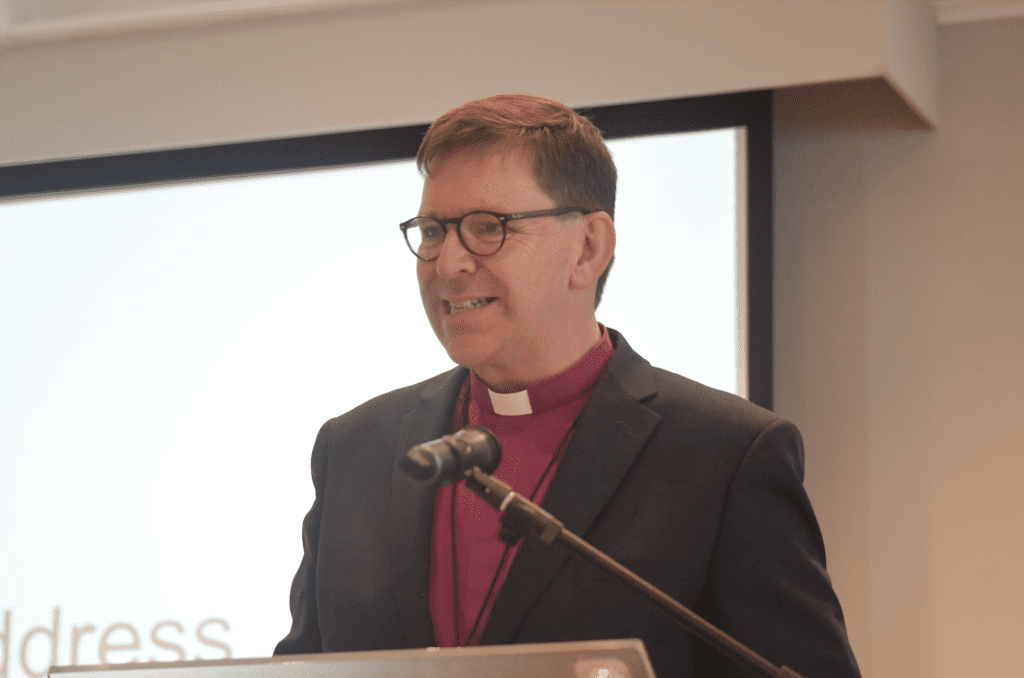
The Bishop of Derry and Raphoe, Rt Rev Andrew Forster, has told clergy and lay members of the Church that “God is stirring hearts again” and that he sees signs of hope all across our diocese.
In his Presidential Address to the 2025 Diocesan Synod, Bishop Andrew said God was “calling people to rediscover faith, meaning and hope”, and that we mustn’t be left behind in this. “This is a wave of the Spirit,” he told the Synod, “and this is a call for us to be open, to be welcoming, to be vocal about our faith – to see our churches as places of faith and hope and love, to realise we have a message to offer that is transformative.
“Too often,” the Bishop said, “we lament our falling numbers or the challenges of maintaining historic buildings. But what if we changed the narrative? What if we saw ourselves not as caretakers of decline but as people of hope?”
Bishop Andrew said he didn’t make his remarks lightly, but against a backdrop of a world in deep pain. “We have observed, with horror, the immense suffering caused by the ongoing conflict in Israel and Gaza, the continuing war in Ukraine, and the largely forgotten conflicts in Sudan and the Democratic Republic of Congo. Sadly, that is not an exhaustive list.
“We live in uncertain, unpredictable, indeed, volatile times. The political and social order that has shaped the world since the end of the Second World War seems to be crumbling before our eyes.” Many people had felt powerless in the face of what has been happening in the world in recent years, Bishop Andrew said, and yet we could imagine how different and how much better our world would be if we lived up to the commands and to the call of Jesus Christ.
Bishop Andrew said there was “a growing spiritual hunger – a restlessness with the emptiness of secularism”, and that churches were beginning to see new faces. “Dare I say, this is what we have been praying for, for years? People are searching once again for truth, for meaning, for something deeper than the soulless babble of modern life. This is particularly noticeable in young people whose parents – my generation – walked away from church, and their children are now perhaps seeing that the secularism their parents embraced simply doesn’t work.”
This year’s Synod heard an interim report from the diocese’s two Archdeacons which shared the results of an extensive consultation exercise undertaken as part of the ongoing Diocesan Review. Almost 1,200 people responded to an invitation to share their thoughts on the challenges and opportunities facing the diocese, as well as on diocesan values and identity, and on future church structures.
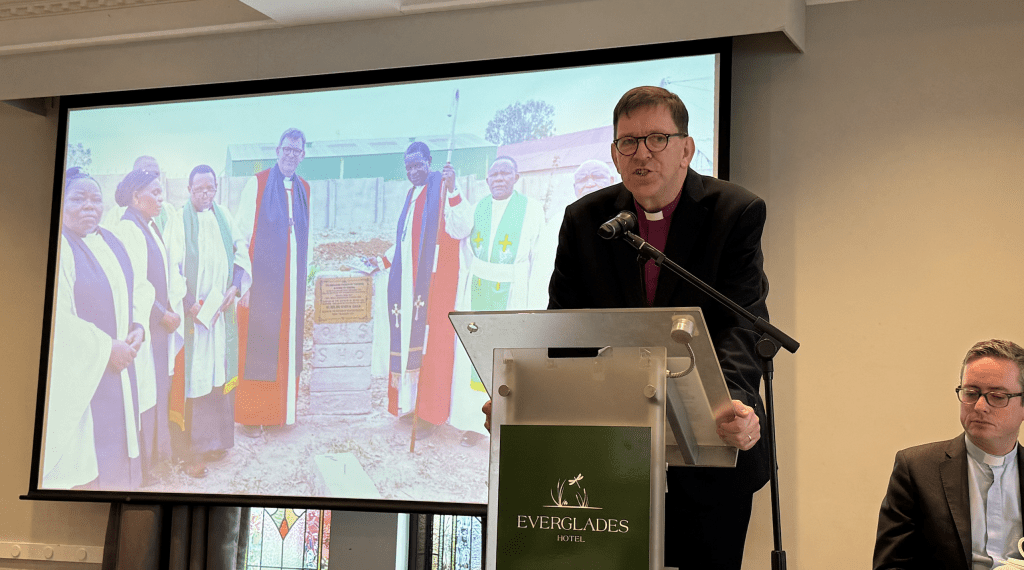
Synod delegates were updated, too, about the companion link with the Diocese of Kondoa in Tanzania, which was inaugurated at last year’s Diocesan Synod and is being facilitated by CMS Ireland. The diocese has agreed to support the building of a new diocesan centre in Kondoa to strengthen mission and ministry there, and a £30,000 fundraising target has been set. Bishop Andrew said he was delighted that several parishes and individuals had already begun to contribute through donations, coffee mornings, and breakfasts. “I would encourage every parish to consider getting involved – together we can make a real and lasting difference in the lives of our brothers and sisters in Christ. So, let’s get generous, let’s get giving, and thanks everyone for your support for that.”
Bishop Andrew’s full Presidential Address is reproduced below.
My brothers and sisters in Christ,
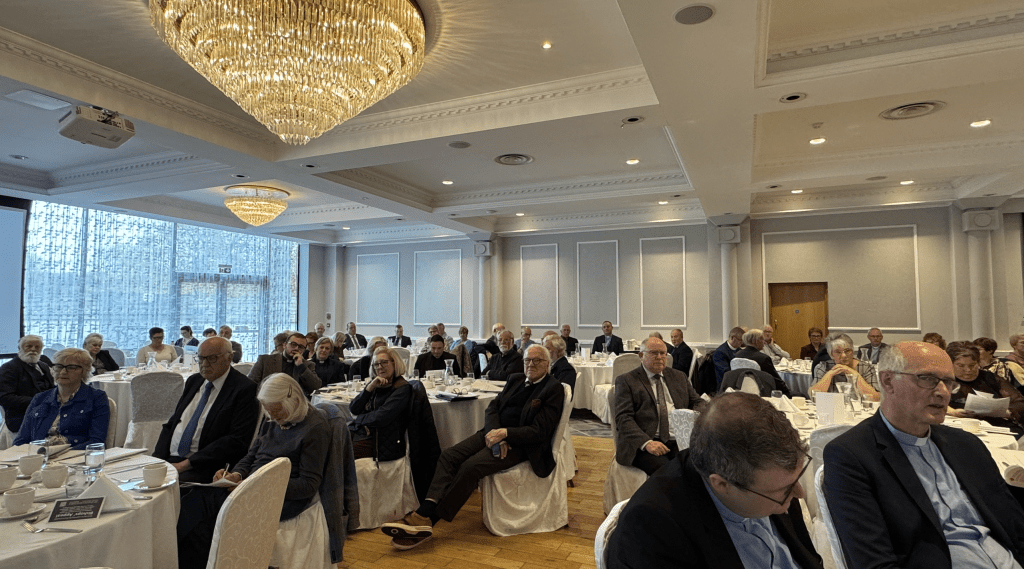
It is a joy and privilege to welcome you all – clergy, lay members, friends and guests – to this year’s Diocesan Synod. Each of you, in your different ways, represents the living, breathing Church in your local context – faithful people who give of your time, your gifts, and your hearts to serve Christ and his Church. Thank you for your dedication to your parishes, and for the countless ways in which you bless and enrich the life of this diocese.
We are, indeed, a wonderfully diverse diocese – stretching from the bustling streets of this city to the quieter rhythms of town and village; from the rugged beauty of our western and northern coastlines to the rich, rolling farmland of our rural heartland. We are unique, too, in being a thoroughly cross-border diocese – there are other cross-border dioceses as you know but we’re thoroughly cross-border, two-thirds in Northern Ireland and one-third in the Republic of Ireland. We live and work under different governmental jurisdictions, shaped by different political outlooks and traditions, and yet we gather today as one family, as brothers and sisters in Jesus Christ, as one family under God.
What binds us together is far stronger than anything that would ever seek to divide us. That must always be the truth of the church of Jesus Christ, that what binds us together is much stronger than what would ever seek to divide us. We gather in warm and genuine fellowship, united in purpose – witnessing through faith, hope and love – as we seek to serve God in this beautiful corner of Ireland. This unity in diversity is a gift to us and it’s a witness to the world: that what others might see as fragmentary, Christ’s love holds together.
We live in a climate of dissension, of dissembling and of disagreement, yet the church is called to live in a different way, living out the truth that when we agree – and even when we disagree – Christ’s love holds us together.
GRATITUDE AND APPRECIATION
All of us who are called to serve God and His church, and that’s everyone in this room, know that we cannot possibly rise to that enormous challenge in our own strength; we do so through God’s equipping power and grace. I feel, though, that I have been blessed by God with the wonderful support team in our diocese.
So, before delving more deeply into the business of Synod, I want to acknowledge my deep sense of gratitude to a few individuals who contribute so much to the life and work of our diocese.
To the staff in our Diocesan Office, thank you for your dedication and professionalism. To Kirsty McCartney, our Children’s Ministry Officer; Claire Hinchliff, our Diocesan Youth Officer; Jocelyn McKeown, our Safeguarding Compliance Officer; Gordon Robinson, our caretaker; and Paul McFadden, our Communications Officer – your energy, creativity, and commitment enrich the ministry we share and strengthen our work across every parish.
Huge appreciation must go to Gavin Harkin, for all the work he has done not just in organising today’s gathering, and for his ongoing commitment and expertise as Diocesan Secretary – we are deeply grateful for you, Gavin.
To Archdeacon Robert Miller and Archdeacon David Huss, thank you for the steadfast support and wise counsel you offer to me and to all across our diocese, and also for your gift of friendship. It is deeply appreciated.
To Joanne Miller, my wonderful secretary, who ensures I arrive at the right place at the right time – and does so much more behind the scenes to support my ministry – thank you so much for that.
I also want to acknowledge the huge contribution made by our Honorary Secretaries who do so much of the ‘heavy lifting’ in the day-to-day life of the diocese, and they do it with good humour, with great grace and with deep commitment.
And to all of you, all of the clergy, all of the laity gathered here, thank you for your service, for your prayers, for your care, for your faithfulness – thank you from the bottom of my heart.
I also think today it is worth noting that one of our own, Mrs Kay Clarke, has been elected to the important position of All Ireland President of the Mother’s Union. This is an important and influential role – at once a great honour and a tremendous responsibility – and Kay can be assured of our prayers and ongoing support as she leads the Mothers’ Union on this island.
THE WORK OF SYNOD
Today, we have an opportunity to share in the work of our diocesan family. We’ll hear reports, we’ll exchange ideas, we’ll listen to updates from some of our boards and committees – all this is vital to the life and witness of our diocese.
A particular highlight this year will be an important and eagerly anticipated update on our Diocesan Review. I want to express my heartfelt thanks to everyone who has contributed so thoughtfully to this process – at meetings, in conversations, by taking part in the online survey. I want to assure everyone who has contributed that your voices have been heard. Your insights and experiences will help chart our course as a diocese for the foreseeable future.
The review is of enormous strategic importance to us. It is looking at the culture of our diocese – who we are, what matters to us, what we want to look like and how we see ourselves in the future. As we contemplate these critical issues, our deliberations will help us to discern what our structures should look like – both parochial and diocesan – if we’re to be properly equipped for mission and ministry into the future.
Also, today we’ll be hearing from some of our visitors, and I encourage you to take some time during the breaks in synod business to browse among the stalls in the foyer here and visit the exhibitors’ stands. There’s a great deal of good work being done right across the Church and the wider community – and it’s always worth seeing, supporting and learning from it.
OUR LINK WITH KONDOA
Most of you will recall that at last year’s Synod we inaugurated our new companion link with the Diocese of Kondoa in Tanzania. We had the joy then of welcoming Bishop Given Gaula among us and, this summer, Heather and I were blessed to pay a return visit to Kondoa – and what a remarkable and rewarding experience it was.
We travelled through breathtaking countryside and were received everywhere we ventured with warmth and joy. We visited parishes, some still meeting under trees, and took part in a number of confirmation services. The shortest of those services lasted two and a half hours; the longest, four and a half hours. At one service I was even asked to make my sermon longer! That was a notable first for my ministry.
Kondoa is a young diocese, full of vitality and enthusiasm. By contrast, we are an ancient diocese, with deep roots and a long story of faith. So, there’s much we can learn from each other in partnership. And I want to thank CMS Ireland for facilitating that partnership so well and with such professionalism.
The growth of the Church in Kondoa has been extraordinary – from just three church buildings 14 years ago to 71 today (and still growing). Their faith is vibrant, exuberant, joyful, and deeply dependent on God. We can share with them something of the steadfastness and maturity that come with longevity, while they can remind us what it looks like to live with bold, expectant faith.
We have agreed as a diocese to support Kondoa in building a new diocesan centre to strengthen mission and ministry there.
Our target is to raise £30,000. I am delighted that several parishes and individuals have already begun to contribute through donations, coffee mornings, and breakfasts, and I would encourage every parish to consider getting involved – together we can make a real and lasting difference in the lives of our brothers and sisters in Christ. So, let’s get generous, let’s get giving, and thanks everyone for your support for that.
SIGNS OF RENEWAL
What we saw in Kondoa – that youthful energy of the Spirit – has parallels here at home. Across these islands there’s a sign of what is being called a quiet revival, especially among young people. I was talking to a schoolteacher in one of the schools in our diocese recently; they had to move the Scripture Union from a classroom to the assembly hall because there are so many young people wanting to attend. Churches are beginning to see new faces; there’s a growing spiritual hunger – a restlessness with the emptiness of secularism.
One recent report noted that sales of printed Bibles have increased by 41%, and downloads of Bible apps by 79%. Dare I say, this is what we have been praying for, for years? People are searching once again for truth, for meaning, for something deeper than the soulless babble of modern life. This is particularly noticeable in young people whose parents – my generation – walked away from church, and their children are now perhaps seeing that the secularism their parents embraced simply doesn’t work.
As St Augustine so beautifully put it: “You have made us for yourself, O Lord, and our hearts are restless until they find their rest in you.”
God is stirring hearts again. He is calling people to rediscover faith, meaning and hope, and we mustn’t be left behind in this. This is a wave of the Spirit, and this is a call for us to be open, to be welcoming, to be vocal about our faith – to see our churches as places of faith and hope and love, to realise we have a message to offer that is transformative.
Too often we lament our falling numbers or the challenges of maintaining historic buildings. But what if we changed the narrative? What if we saw ourselves not as caretakers of decline but as people of hope?
I see signs of hope all across our diocese – the encouragements that I feel week in, week out by visiting parishes, attending services, hearing about new projects – there is hope. Let’s be people of hope, not caretakers of decline. And let’s get behind those hopeful projects that are bubbling up around our diocese. Later on, we’ll hear about pioneering ministry and all that is happening. God is at work among us. Our parishes are places of rich community, deep compassion, and genuine care. They are outposts of the Kingdom, places of witness where faith is nurtured, hope is rekindled, and love is shared.
This is exactly what I hope our Diocesan Review will help us to rediscover – how we can best use the talents we have, imagine new possibilities, and step out in faith and faithfulness.
In this ancient diocese of ours, I sense the wind of the Spirit moving afresh – stirring new hope, breathing new life, revealing new opportunities to grow in faith and hope and love.
A FRAGILE WORLD
And yet, I don’t say this lightly. I say it against a backdrop of a world in deep pain. We have observed, with horror, the immense suffering caused by the ongoing conflict in Israel and Gaza, the continuing war in Ukraine, and the largely forgotten conflicts in Sudan and the Democratic Republic of Congo. Sadly, that is not an exhaustive list.
We live in uncertain, unpredictable, indeed, volatile times. The political and social order that has shaped the world since the end of the Second World War seems to be crumbling before our eyes.
I have been struck this past year by the frequent use of the word ‘disrupter’ to describe some of those who have come to the fore on the global stage. The term is bandied about as if the phenomenon was something new. It isn’t. Two thousand years ago, Jesus Christ came among us. He was a disrupter, but his motives were entirely different to some of those of politicians who are agitating for change now. Jesus came to serve. He sided not with the rich and the powerful, but with the poor, the weak and the marginalised. He challenged those in authority. He challenged the multitudes who heard him preaching during his ministry. And now, two millennia later, he challenges us – those of us who profess to follow him.
“Love the Lord your God with all your heart and with all your soul and with all your mind.” “Love your neighbour as yourself.” Feed the hungry. Welcome the stranger. Care for those who are sick. Visit those in prison. Those are ‘big asks’, but they are not optional extras for the people of God. There are no short cuts when we decide to walk with Jesus Christ.
Jesus’s message was radical two thousand years ago, and it is just as radical and just as relevant today. Many of us have known despair and felt powerless in the face of what has been happening in our world these last few years. And yet we can imagine how different and how much better our world would be if we lived up to the commands and to the call of Jesus Christ.
This onus is on all of us, not just on those in positions of power globally, this onus is on all of us to stand up for what is right, not just for what is profitable, not just for what is in our own strategic or economic interest – but to stand up for what is right, to do the right thing, because we’re followers of Jesus Christ.
We pray that leaders would grasp that, and we pray that we would grasp that truth as we live our lives, and that we would see swords turned into ploughshares; that we would see governance for all, not just for a few; and that we would see good stewardship of our world in its crises – both economic and environmental – and in the wars that we face.
In the Book of Proverbs we read these words: “When the foundations are shaking, what will the righteous do?”
The foundations are indeed shaking. And yet we are not without hope. We return to St Paul’s great words: “And now these three remain — faith, hope, and love. And the greatest of these is love.”
Our society, our society in Derry and Raphoe, let alone across the world, desperately needs hope, and we are called to be a community of hope. Hope fuels us to act, to serve, to give, and to reach out to those in need – both materially and spiritually.
Over all these things, however, stands the greatest of all: love – God’s unshakeable love for each one of us and for His world. It is love that brings forgiveness and healing; it is love – the love of God – that has transformed your life; it is love that renews; it’s his love that brings transformation; and his love that builds a foundation that no turmoil can destroy.
LOOKING AHEAD
We are a growing diocese (our census has actually shown that over the last two censuses). It’s modest growth, but it is real and tangible. I long to see more, not just numerical growth – though I pray for that – but deeper growth: growth in faith, growth in hope, and growth in love.
Today, as we gather in faith and fellowship, may God bless our conversations, our deliberations, our decisions and most of all our friendship and fellowship. May our synod be filled with faith to believe, hope to persevere, and love to serve.
“A new commandment I give you,” Jesus said. “Love one another. As I have loved you, so you must love one another. By this everyone will know that you are my disciples, if you love one another.” (John 13: 34-35)
I pray that whenever we go home today, we will go home strengthened in heart and in mind to love one another, and not just to proclaim but to model the good news of Jesus Christ in this city, in the towns and villages, across the hills and around the coasts of Derry and Raphoe. And to the glory of God, and the blessing of His people, we commit ourselves to this task.
Amen.